Workshop services
Cut & Edge Services: Inside a Real Workshop
Step inside a cut-and-edge workshop: see how panel saws, edge banders, drills, CNC routers and presses turn a cutting list into cabinet components.
By AnyCutlist · Published
The business problem
A pile of boards arrives. A cabinet kit leaves.
Between those two moments, a cut-and-edge workshop does much more than shorten a sheet. It selects the right material, sizes the panels, finishes exposed edges and, where ordered, machines the holes and grooves that make assembly possible. A shelf can be cut perfectly and still be wrong if its grain runs sideways or its front edge is unfinished.
Follow a cabinet job through the workshop
From the cutting list to labelled components
- 01
Specify
Confirm materials, finished sizes, quantities, grain and machining details.
- 02
Cut
Plan the sheets and size the panels on a saw or CNC nesting machine.
- 03
Edge
Apply the chosen edging to the specified sides, then trim and finish the banding.
- 04
Machine
Add the ordered holes, grooves, pockets and shaped features.
- 05
Check
Inspect, label, group and pack the components for collection or delivery.
First agree what the service includes
A cut-and-edge order usually starts with a parts list rather than a complete kitchen design. The customer or designer supplies the components required; the workshop confirms what it can manufacture. Some suppliers sell the boards and edging, while others also process customer-supplied material. Confirm responsibility for stock, offcuts, damaged sheets and transport before comparing quotes.
Choose the board by specification: substrate, grade, thickness, decor or veneer, face quality and sheet size. Then agree whether listed dimensions mean the finished component, including edging, or the raw blank. Edging thickness, pre-milling and machining allowances can change the blank size. Those decisions belong in the job instructions, not in an assumption at the saw.
| Service | Typical equipment | What the customer receives |
|---|---|---|
| Cut to size | Sliding-table saw, beam saw or CNC nesting router | Panels sized to the agreed specification |
| Edge banding | Straight-line edge bander; separate equipment for contours | Specified edges covered and trimmed |
| Drilling and boring | Hinge borer, line borer or CNC drilling centre | Holes positioned for the selected hardware |
| Grooves and shaped work | Router or CNC machining centre | Specified grooves, rebates, pockets and profiles |
| Pressing and surface finishing | Press, sander and finishing equipment, where offered | Bonded or finished panels to an agreed scope |
| Packing and dispatch | Inspection bench, labels and protective packaging | Identifiable components ready for the next stage |
Cutting: the panel saw turns sheets into parts
On a sliding-table panel saw, the moving table supports the panel as it travels past the blade. A scoring unit, where fitted and correctly set, helps reduce breakout on the underside of coated boards. This is a flexible arrangement for a workshop handling varied jobs.
A beam saw holds the panel under a pressure beam while a saw carriage makes the cut. Automated positioning and handling suit repeated panel work. CNC nesting is another route: a router cuts components from a sheet on a table and can combine cutting with other machining. The appropriate route depends on the material, geometry, batch and equipment available.
Before cutting, the workshop plans the sheets around blade or tool kerf, trim, grain and permitted rotation. A high material-yield percentage is useful only if every required part is present and the cutting sequence suits the machine. Labels help keep similar-looking shelves, sides and partitions attached to their instructions.
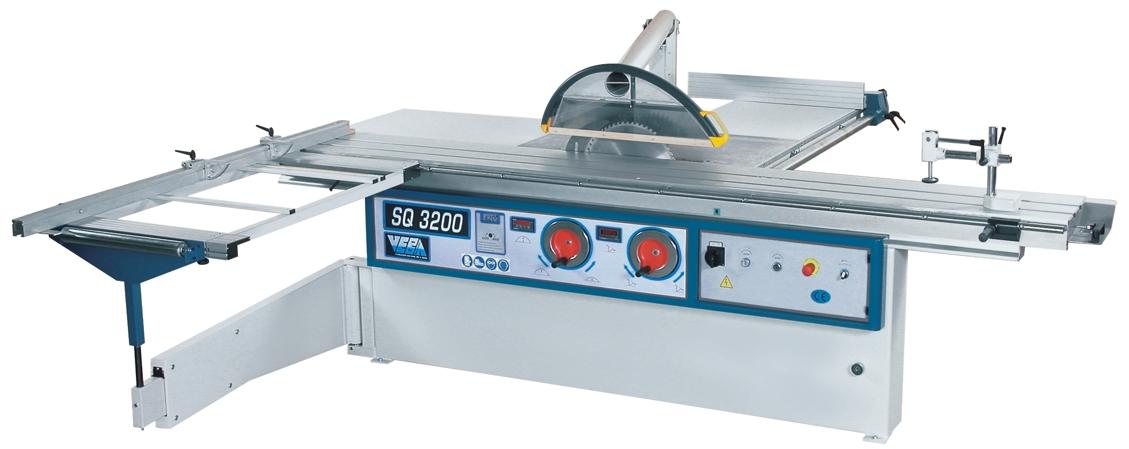
A sliding-table panel saw supports sheet material during sizing. This is an illustrative machine photograph, not a photograph of the suppliers discussed below.
Image: VEBA MECCANICA SRL / Wikimedia Commons · Free-use permission


Edging: covering the exposed board core
Cut melamine-faced particleboard or MDF exposes its core at the edge. Edge banding covers that edge with the specified material, often ABS, PVC or veneer. Solid timber lipping is another option where offered. Colour, thickness, texture and which sides receive it all matter: a door perimeter and a concealed cabinet back have different requirements.
A straight-line edge bander feeds the panel through a sequence of stations. Depending on its configuration, it may pre-mill the edge, apply adhesive and tape, press them together, trim the ends and excess material, then scrape and buff the result. EVA and PUR are adhesive options; choosing PUR does not make the entire board waterproof. Curved parts may need a separate contour-edging process.
Write the required edges explicitly. Codes such as 1L and 2W can express counts along the length and width dimensions, while EAR commonly means edge all round. Agree the convention with the supplier, and mark the actual sides on a drawing when their positions matter. An edge count alone cannot identify a particular front, back, left or right side.
For an illustrative 800 × 400 mm panel edged all round, the perimeter is 2.4 metres. Two such panels need 4.8 metres before any agreed trimming or waste allowance. That quantity is different from the number of panels and from the sheet area used to cut them.
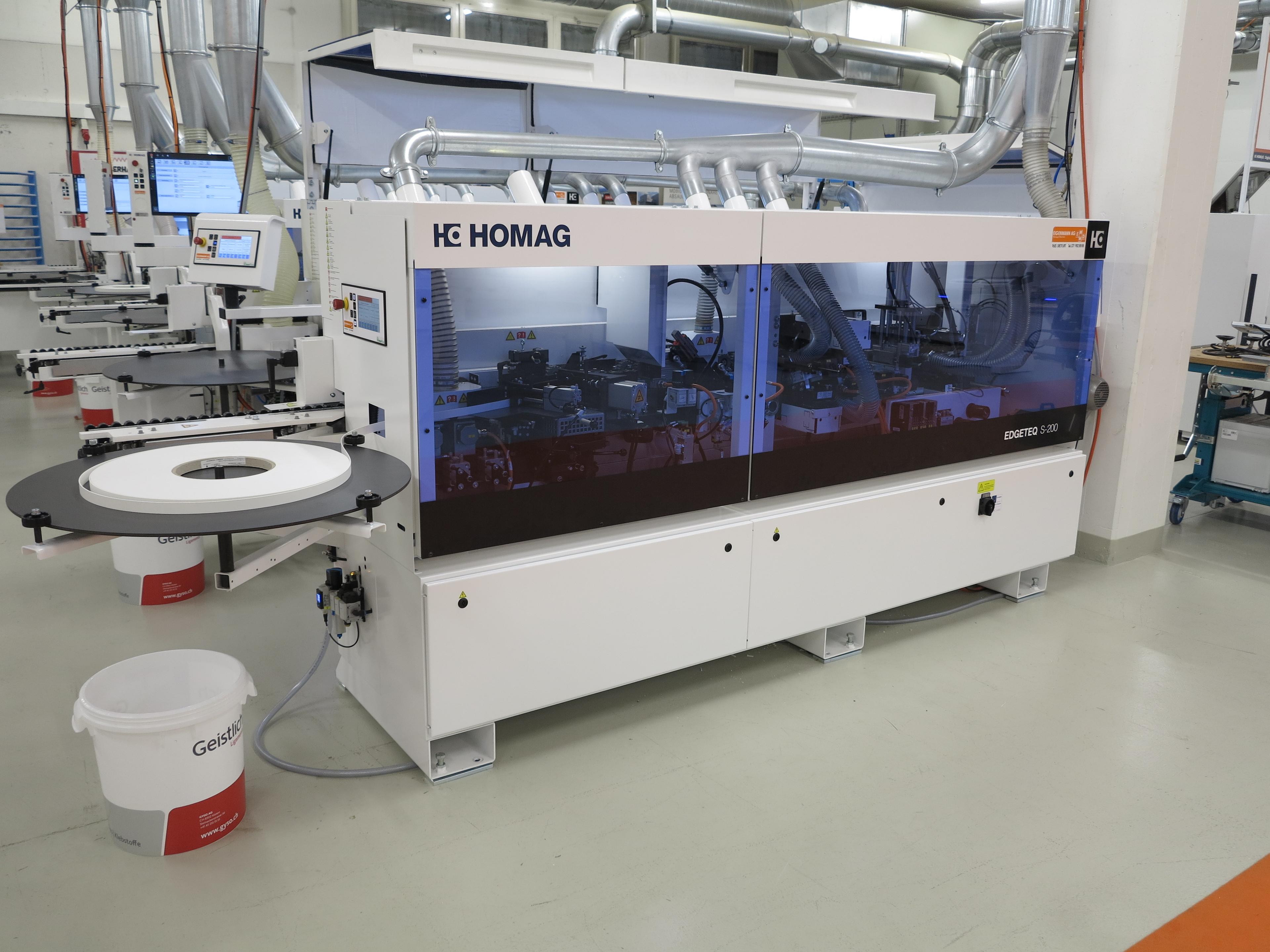
A HOMAG EDGETEQ S-200 edge bander. The enclosed stations apply and finish edging as a panel passes through. Photograph displayed at a responsive size; no crop.
Image: 1-Byte / Wikimedia Commons · CC BY 4.0

Drilling: preparing panels for assembly
Hinge cups, shelf-pin rows and connector holes can be made with dedicated boring equipment or a CNC drilling centre. A hinge-boring machine helps repeat a hardware pattern; a line borer creates repeated hole rows. CNC equipment can position several drilling patterns on a part, including face and edge holes where the machine supports them.
The hardware specification controls the pattern. A 35 mm hinge cup is a common example, not a universal instruction: depth, setback, screw positions and clearances depend on the chosen hinge and panel. Supply the hardware reference or approved drawing, identify the machining face and distinguish mirrored left- and right-hand parts.
Grooving and CNC routing: the details need a drawing
A groove may locate a cabinet back, while a rebate removes material along an edge. Routing can also create handle recesses, pockets, radiused corners and shaped outlines. These are different features even when one CNC machining centre can produce several of them.
‘CNC’ describes computer control, not a complete service specification. ‘Groove one length’ also leaves questions unanswered. State the groove width and depth, its offset from a reference edge, the face to machine and whether it stops short or runs through. A sketch with dimensions is often clearer than a line of abbreviations.
The five-step sequence above is a useful way to understand the services, but actual machine order varies. A nesting router may cut, drill and groove a sheet before the parts reach the edge bander; another workshop may saw first and machine the separate panels later.
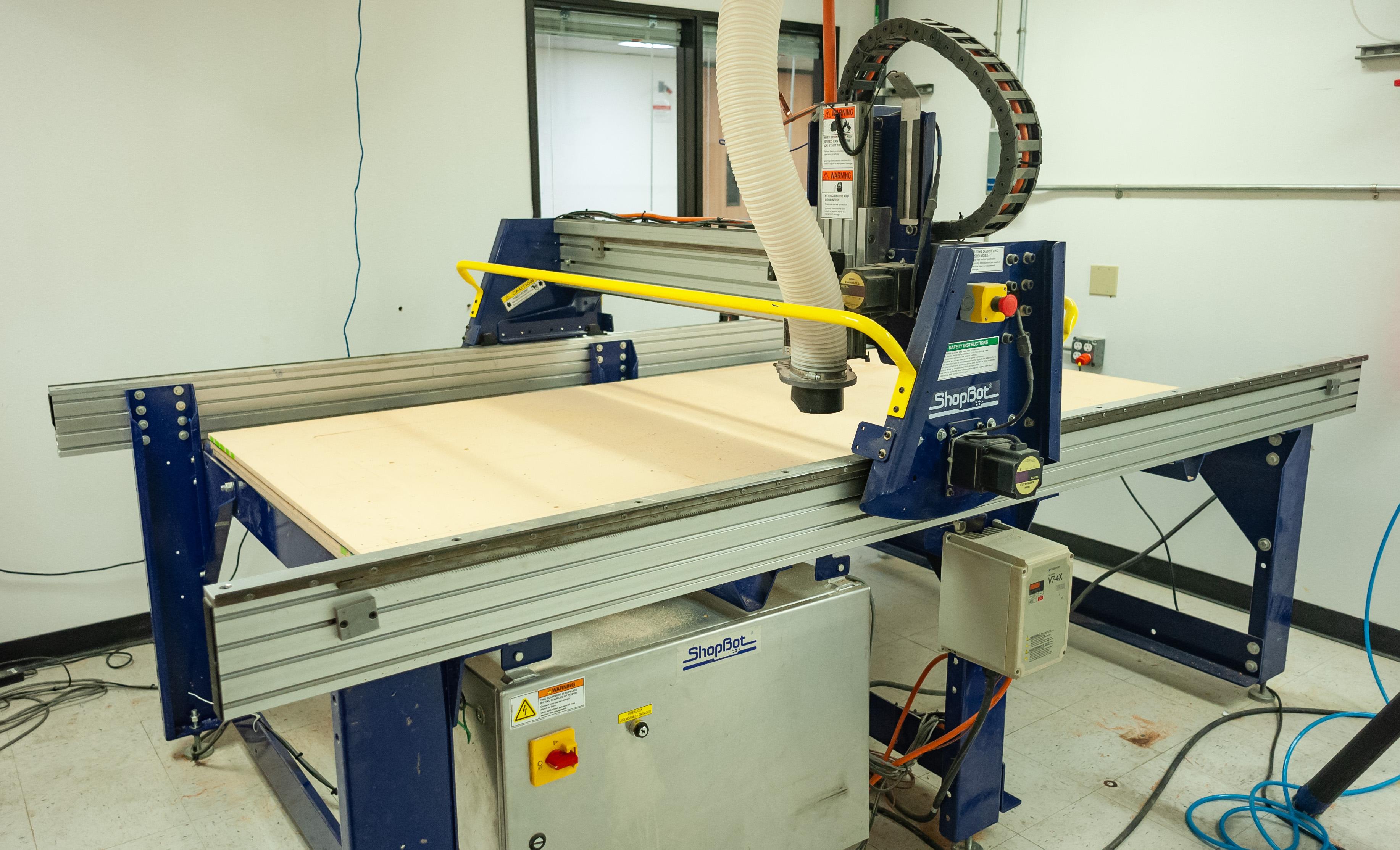
A ShopBot PRS Alpha CNC router at TheShop.build in San Jose. This open-bed machine illustrates CNC routing; tooling and configuration determine the available operations. Photograph displayed at a responsive size; no crop.

Pressing, finishing and dispatch: agree the extra services
Some workshops bond veneers or laminates to a substrate, or press layers together for a thicker component. Cold or hot presses serve different adhesive and production systems. An already faced melamine board does not automatically need another lamination service. For a built-up panel, agree the layer construction and finished thickness rather than assuming two nominal 18 mm boards will finish at exactly 36 mm.
Sanding, spray finishing and polishing may be separate departments or outsourced services. Dust extraction, material handling and storage support the production machines, even though customers usually see them only as part of the workshop's overhead. Ask which surface preparation, finish and inspection are included in the price.
Before dispatch, check quantities, dimensions, edge coverage and machining against the approved job. Labels and grouping by cabinet or room make assembly easier. Packaging protects faces, corners and finished edges. Collection, delivery, assembly and installation should each have an agreed scope; receiving a kit of prepared panels does not by itself include a fitted kitchen.
An example of panel pressing equipment
What large cabinet factories and trade suppliers show us
To ground this guide in real operations, we reviewed published material from major cabinet manufacturers in Europe, North America and China, IKEA's international production business, and specialist trade suppliers in the UK and Southern Africa. They operate at different scales and sell different services, so they do not form a like-for-like global ranking.
The practical lesson is that a component needs an identity and a specification as it moves between processes. OPPEIN explicitly describes unique panel identification across cutting, edging and drilling. Cutwrights shows how those same operations can be sold as separate services to a customer bringing a parts list. A smaller workshop can apply that principle with clear labels and one approved job record.
Explore the real operations behind the guide
- nobilia · Germany ↗Describes itself as Europe's largest kitchen manufacturer: an example of cabinet production at industrial scale.
- Howdens · United Kingdom ↗Describes UK cabinet manufacturing in Yorkshire and Cheshire, alongside door and worktop production.
- MasterBrand · North America ↗Describes itself as North America's largest residential cabinet manufacturer, serving several cabinet markets.
- IKEA Industry · International ↗IKEA's own large-scale wooden-furniture manufacturing business, serving IKEA rather than offering a public cut-to-size service.
- OPPEIN · China and global markets ↗Its factory tour connects panel identification with cutting, edge banding, drilling and automated handling.
- Cutwrights · United Kingdom ↗A specialist panel processor showing how cutting, edging and machining become bookable trade services.
- Timbercity · Southern Africa ↗Its quotation process separates board planning, cutting, edging and delivery. Confirm services with the relevant branch.
What to send with a cut-and-edge order
A useful order lets the workshop quote and manufacture the same scope. Keep the parts list, drawings and revisions together, and resolve unclear handwriting or abbreviations before release. If a dimension changes after quoting, confirm which cutting plan and machining instructions are still valid.
- One part ID, quantity and agreed finished size for each component, in stated units.
- Exact board specification and who supplies it, including thickness, decor and grain direction.
- Edging type, thickness and required sides, with a diagram for position-specific instructions.
- Hardware references and dimensioned machining details: face, location, width, depth and pattern.
- The required surface finish, labels, grouping and packaging.
- The approved revision, delivery or collection arrangement, and whether assembly is included.
Common questions before placing an order
Confirm these points with the supplier before approving the quote, especially when ordering a service for the first time.
- Does cut and edge include cabinet assembly?
- Only if the quotation says so. A cut-and-edge service may supply sized and edged panels, with drilling or other machining added separately. Assembly, hardware supply, delivery and installation each need an agreed scope.
- Can a CNC router replace every other machine?
- A nesting router can combine sheet cutting with drilling and routing, depending on its tooling. Edge banding is usually a separate process, and dedicated saws or drilling machines may suit a workshop's work better. Ask what finished operations the supplier offers.
- Can I bring my own boards?
- Some processors accept customer-supplied material; others work only with stock they supply. Confirm the accepted material, sheet condition, minimum charges, handling responsibility and what happens to offcuts before ordering.
- Why does the workshop ask for a drawing when my list says groove?
- A groove needs a width, depth, position and machining face, plus a decision about whether it stops or runs through. The word alone does not tell the operator which feature to make.
Evidence note
Sources and photographs
Researched on 20 November 2026 using the manufacturers' and suppliers' own pages linked beside the relevant sections. Company scale descriptions are attributed to those companies; the examples are not a worldwide league table or supplier endorsements.
This is an explanation of real workshop processes, not a report of a site visit. The three credited Wikimedia Commons photographs illustrate machine types; they do not establish the equipment installed at any named supplier. Capabilities vary by machine configuration and workshop.